Having spent decades immersed in Ontario’s construction and development landscape, I’ve learned to look beyond the headlines and focus on the substance that truly matters to clients. While recent reports reference improved affordability across Canada as fixed mortgage rates rise, it’s worth noting that no concrete figures—be it for home prices, qualifying incomes, or monthly payments—were provided for our local markets. Without these specifics, it’s impossible to draw meaningful conclusions about affordability shifts in any particular community. The broader Canadian data simply doesn’t translate to actionable insight at the town or neighborhood level. As always, I rely on detailed, local information to guide property owners and investors—after all, thriving assets depend on more than just national trends.
Author: Samer Al Hashlamoun
-
Small-Scale Infill Expands Canada’s Housing Supply
Having spent over two decades immersed in Ontario’s construction and development landscape, I’ve seen firsthand how small-scale infill is reshaping our housing supply. While large-scale projects still dominate new construction in many established neighborhoods, it’s the thoughtful additions—those extra homes on existing lots—that are steadily increasing available options. Recent changes to zoning, making it easier for infill projects to move forward, have set the stage for greater supply, especially where communities are open to more homes in familiar streetscapes. We’re seeing a shift: more building is happening on previously developed land, with a move toward denser living and fewer ground-oriented homes than in the past. New policies encouraging ‘missing middle’ housing are promising, but the pace of these projects still depends on factors like municipal fees, approval timelines, and access to financing. For families and investors considering their next move, these small-scale infill projects are becoming a vital source of ground-oriented homes—though their future will rely on keeping projects financially sound. Our multi-generational team is committed to guiding clients through these evolving opportunities, ensuring your properties are not just built, but positioned to thrive for years to come.
-
GTA Market Cools as Prices and Sales Ease
The market across Greater Toronto is showing clear signs of cooling as we move through Early-Q3. Home sales reached around 6,000—down about 1% from last year, ending a four-month streak of annual growth. Month-over-month, activity did tick up slightly by 3%. The average selling price held at approximately $1 million, but the typical-home benchmark slipped nearly 5% from last year, giving buyers continued leverage in most areas. Detached homes saw a modest 1% annual rise in sales, while semi-detached, townhouse, and condo apartment sales were either down or flat. What stands out most to me, with my background in both construction and long-term property management, is the tightening supply: new listings dropped to 14,500 (an 18% decrease), and active listings are down 12% to 26,100. This shrinking pool of fresh options is likely to influence price negotiations, potentially supporting more balanced conditions if buyer confidence returns. As always, navigating these shifts requires a long-term perspective—something our family-led team is proud to provide throughout every stage of the property journey.
-
Happy Thanksgiving
The perfect opportunity to embrace your inner "foodie" and unbutton your pants at the dinner table!In Canada, post-Thanksgiving is all about creative cranberry sauce solutions. Cranberry sauce pancakes, anyone?It's that time when multiple ovens are a blessing. Turkey, pies, casseroles – less stress!
-
August Brings More Affordable Options for Canadian Homebuyers
August brought a modest shift in the Canadian real estate landscape, with home sales dipping by 0.7%—the first slowdown we've seen since spring. While inflation concerns and talk of possible rate hikes weigh on the market, new listings actually rose by 3.3%. The sales-to-listings ratio remains balanced, suggesting a steady environment for both buyers and sellers. Prices held steady month-over-month, though they’re still 3% lower than this time last year. Navigating market changes is always a part of the property lifecycle; with our decades of hands-on experience in Ontario construction and development, we’re committed to guiding clients through each phase to ensure long-term asset strength and value.
Continue to full article -
Canada Home Prices Hit Their Lowest Since 2023
Home prices across Canada have now reached their lowest point since early Q2 2023. The national index tracking 11 key metropolitan areas slipped less than 0.5% month-over-month, marking eight declines in the past nine months and erasing the modest gains we saw earlier. Overall, national prices are now down about 4% from the late Q4 2025 peak—just under a year ago. Even the adjusted measure, which had held steady for six months thanks in part to job stability and affordability, pulled back by roughly 0.5% this round. Regionally, Vancouver, Hamilton, and Toronto saw the sharpest drops, while markets like Quebec City, Montreal, and Winnipeg continued to show resilience with gains. As we look forward, higher bond yields are expected to push up new mortgage costs, further challenging borrowing capacity and affordability—especially as home sales start to fall again. Having guided clients through all facets of Ontario’s property landscape for over two decades, I understand how these broader shifts impact both new builds and long-term property management. Our family-led approach is designed to help you navigate market changes while protecting and maximizing your real estate assets for the future.
-
Mortgage Rates Face a New Reality
Borrowing costs in Canada are holding steady at elevated levels, and this continues to shape the housing landscape in ways that can’t be ignored. While many are hoping for rate relief to ease affordability, the reality is that much depends on inflation, the broader economic picture, and the direction set by the Bank of Canada. In our experience guiding clients through every stage of the property lifecycle, we’ve seen how these factors influence not only buying decisions but also refinancing strategies and long-term investment planning. Caution among buyers is understandable, and with higher financing costs affecting purchasing power, it’s more important than ever to plan with current conditions in mind, rather than banking on future rate changes. Our multi-generational approach is grounded in helping families and investors adapt and thrive, regardless of where rates stand.
-
Ontario Builders Prepare for Growth with New Investments
Navigating Ontario’s construction landscape has always required foresight, but current tariff disputes between Canada and the U.S. are presenting new challenges. Builders are now seeing home construction costs rise by $9,000–$14,000 for single-family homes and $18,000–$28,000 for mid-rise units. These increases ripple through every stage—from sourcing materials to sustaining jobs, influencing housing starts, and shaping affordability across the North American market. With over two decades of experience in Ontario’s construction and real estate development, our family-led team is committed to guiding clients through shifts like these, ensuring that your properties are not only built with resilience but managed for long-term value.
Continue to full article -
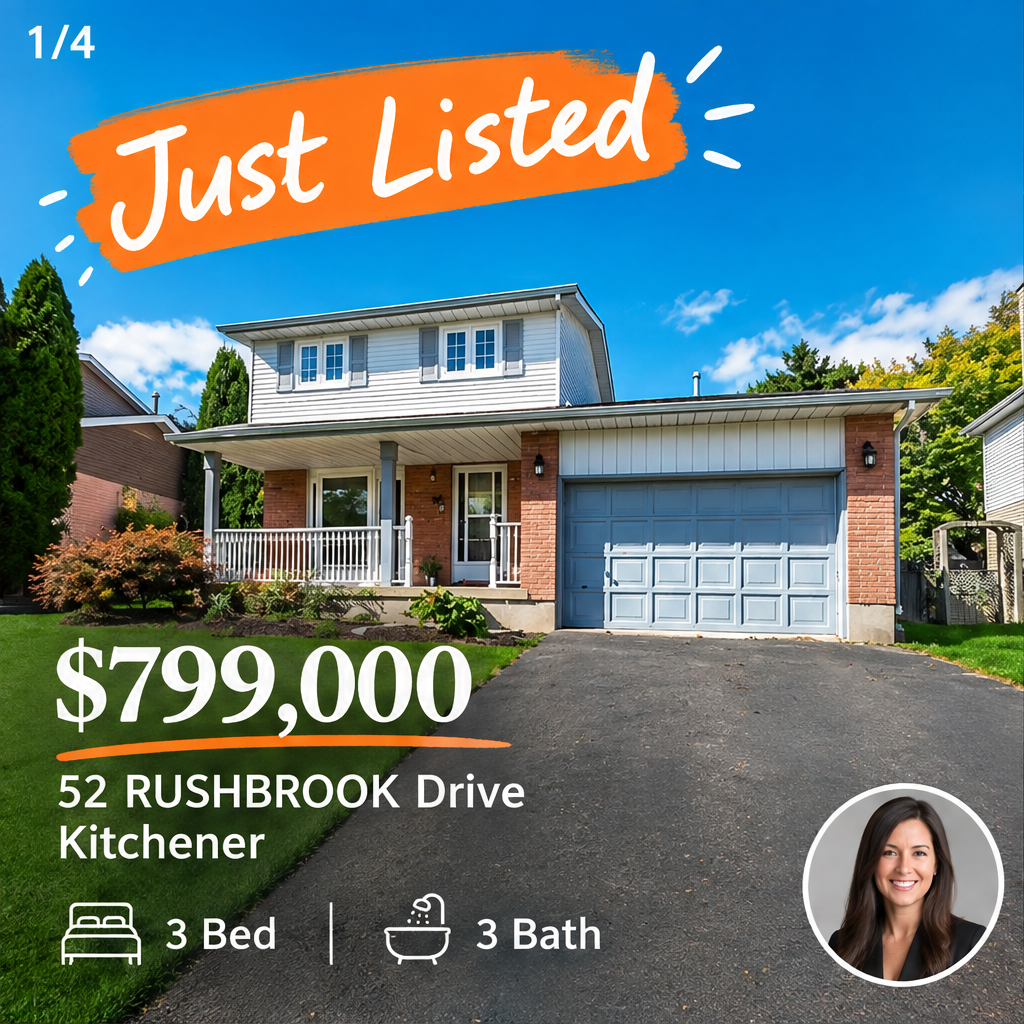
Kitchener Living Starts Here: 52 Rushbrook Drive
Welcome to 52 Rushbrook Drive, Kitchener—a home designed to give you room to live, grow and make lasting memories. Listed at $799,000, this 3-bedroom, 3-bathroom house offers an appealing balance of comfort, functionality and everyday convenience.
With three bedrooms, there is flexibility for a growing household, guests, a home office or a personal retreat. Three bathrooms add practicality to busy mornings and entertaining, while the overall layout provides a welcoming foundation for your lifestyle.
Kitchener continues to attract buyers seeking a vibrant community and strong housing options. For context, recent Regional Municipality of Niagara market data shows a median residential sale price of $569,800 in August 2026, making it especially important to evaluate each property’s features, location and value on its own merits.
Could 52 Rushbrook Drive be your next address? Contact us today to schedule a private tour, ask questions and explore how this Kitchener home could fit your plans.
Continue to full article